1
Send this first (for breaking trust)
Trust is repaired by time and evidence, never by argument.
I broke something that took years to build and I know an apology does not rebuild it. I am sorry, and I am not asking for anything today.
Trust is repaired by time and evidence, never by argument. The apology here is not the repair — it is only permission to begin one, and it should say so honestly. What follows is written for exactly this — messages you can send to your sister-in-law in the next few minutes, plus the part most advice skips: what to leave out.
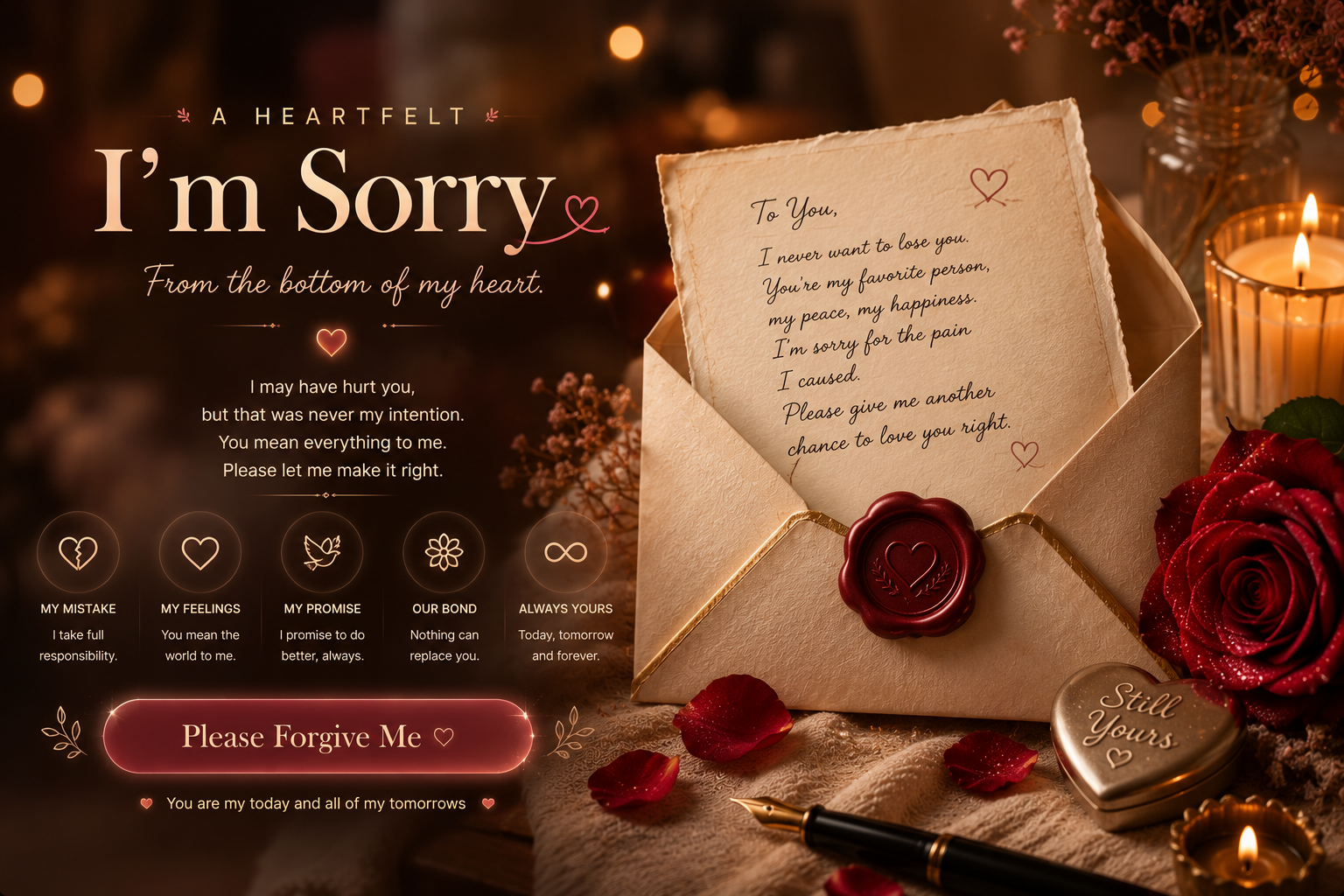
The best sorry message for a sister-in-law for breaking trust is one that takes responsibility for a specific action, acknowledges the effect it had, and asks for nothing in return. Do not ask for a second chance in the apology. Say plainly that you know trust is earned back slowly, and that you are prepared for that to take as long as it takes. Removing the request is what makes it credible. On BuildNectic you can also send a personalised sorry website — a private apology page that opens slowly instead of in a notification bar — your words paced line by line, your photos, and a folded paper letter they unfold themselves — which arrives as a single private link on WhatsApp and needs no app or account to open.
Trust is repaired by time and evidence, never by argument.
I broke something that took years to build and I know an apology does not rebuild it. I am sorry, and I am not asking for anything today.
A different angle on the same first move, in case the first one is not how you speak.
I am not going to ask you to trust me again. I am going to be trustworthy and let you decide when you have seen enough.
A different angle on the same first move, in case the first one is not how you speak.
I am sorry. I understand if this takes a long time, and I am not going to rush you through it for my own comfort.
Asks for nothing, so there is nothing they have to decide right now.
I was wrong. I am sorry. No excuse for it.
Says the specific thing you did instead of apologising for the situation.
I have written this three times and deleted it twice, which probably tells you how much I have been thinking about it. I was wrong. Not partly wrong, not wrong-in-context — wrong. You raised something that mattered to you and I treated it like an inconvenience, and then when you reacted I acted like the reaction was the problem. It was not. I was. I am sorry. I am not asking you to move past this on my timeline. I only want you to know that I understand what I did and that I am not planning to repeat it.
Written to be read slowly rather than glanced at in a notification.
I am sorry, and I am also aware this is not the first time. The honest version is that I get defensive the second I feel criticised, and then I make you handle my defensiveness instead of the actual issue. That is a pattern and it is mine to fix.
Addresses the pattern, which is what they are actually waiting to hear.
i am sorry. i have thought about what i did. i am prepared to be nice to you for an unreasonable amount of time as compensation.
Enough to restart things without forcing an immediate answer.
I want to apologise for the delay on this. It was my responsibility and it held things up for the rest of the team. I have already put a fix in place so it does not repeat.
For the apologies that have to travel before you can.
I was wrong and I am sorry.
When the only thing left to add would be an excuse.
I said the thing I cannot unsay, and I have been living in the echo of it since. I am sorry. I would trade a great deal to have that thirty seconds back.
The one you would rather not send, which is usually the one that works.
I am sorry. Not sorry that you are upset — sorry that I did it. I know exactly which part of that hurt and I am not going to pretend otherwise.
So the night does not do the damage that the argument started.
I have been sitting with this all day and I do not like what I found. I hurt you, and the worst part is that some part of me knew it while I was doing it. I am sorry. Really sorry. You do not have to reply to this.
A long apology in a chat window gets read in three seconds between other notifications. The same words on a private page open slowly — one line at a time, with old family and childhood photos behind them and a folded letter they unfold themselves. Same words, completely different reception.
Create the apology page for your sister-in-lawPut down what you actually want to say, with as much space as it needs.
Attach the pictures that remind them why this is worth repairing.
Share it privately — no app, no account, nothing for them to install.
Do not ask for a second chance in the apology. Say plainly that you know trust is earned back slowly, and that you are prepared for that to take as long as it takes. Removing the request is what makes it credible. Whatever you send, send it once and then stop. Repeated messages shift the weight of the situation from what you did onto how you are feeling about it, and your sister-in-law then has to manage both.
Avoid anything that contains the word "but", anything that describes your intentions, and anything that ends in a question. Each of the three moves the conversation back to you — and for breaking trust, your sister-in-law is not looking for your perspective yet.
The best sorry message for a sister-in-law for breaking trust is one that takes responsibility for a specific action, acknowledges the effect it had, and asks for nothing in return. Do not ask for a second chance in the apology. Say plainly that you know trust is earned back slowly, and that you are prepared for that to take as long as it takes. Removing the request is what makes it credible. On BuildNectic you can also send a personalised sorry website — a private apology page that opens slowly instead of in a notification bar — your words paced line by line, your photos, and a folded paper letter they unfold themselves — which arrives as a single private link on WhatsApp and needs no app or account to open.
Yes, and it is the option most people are switching to. A BuildNectic sorry website is a private apology page that opens slowly instead of in a notification bar — your words paced line by line, your photos, and a folded paper letter they unfold themselves. You personalise it in a few minutes, get a private link, and send it on WhatsApp — your sister-in-law opens it in their browser with nothing to install and no account to create.
Shorter than you think. A long apology reads as a defence, because length invites explanation and explanation invites excuses. Two or three sentences that name what you did, without a single "but", outperform a paragraph almost every time — save the longer version for when you are face to face with your sister-in-law.
No. The link opens full-screen in any browser on any phone or laptop — no download, no sign-up, nothing for your sister-in-law to install. It works on Android and iPhone, and it stays online afterwards so they can reopen it later.
Silence after an apology is usually processing rather than rejection, and following it with a second message converts it into pressure. Send one message, make it complete, and then leave the next move to them. If several days pass, one short line that asks for nothing — not a repeat of the apology — is the most you should add.
A long apology in a chat window gets read in three seconds between other notifications. The same words on a private page open slowly — one line at a time, with old family and childhood photos behind them and a folded letter they unfold themselves. Same words, completely different reception.
Create the apology page for your sister-in-law