1
Send this first (for shouting)
Raising your voice changes the nature of a disagreement — it makes the other person manage their safety instead of the topic.
I raised my voice at you and that is not something the topic excuses. I am sorry.
Raising your voice changes the nature of a disagreement — it makes the other person manage their safety instead of the topic. That is what needs apologising for, separately from whatever you were arguing about. What follows is written for exactly this — messages you can send to your fiancée in the next few minutes, plus the part most advice skips: what to leave out.
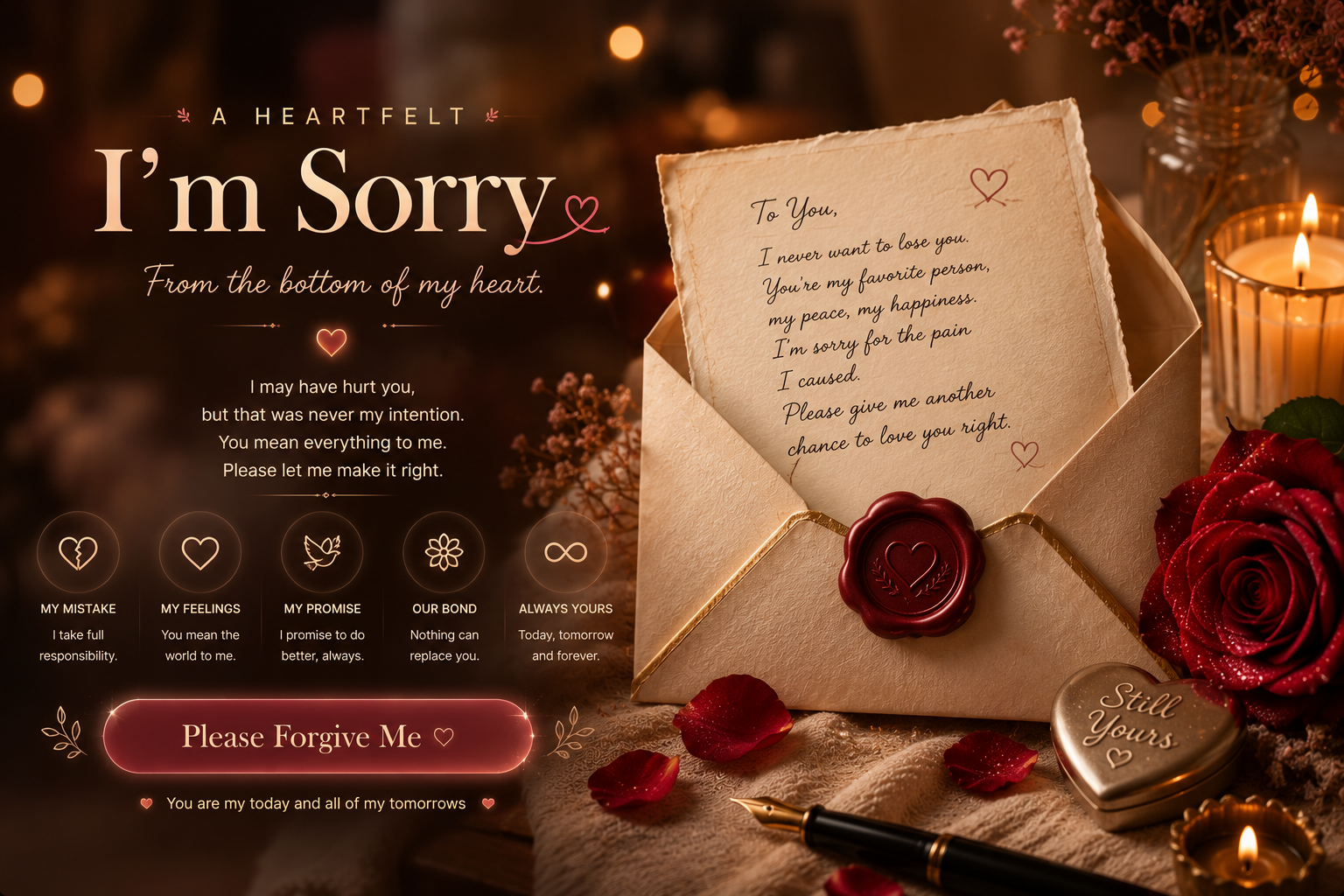
The best sorry wish for a fiancée for shouting is one that takes responsibility for a specific action, acknowledges the effect it had, and asks for nothing in return. Apologise for the volume as its own offence, before you touch the subject of the argument at all. Bundling them together makes it sound like the shouting was justified by the topic. On BuildNectic you can also send a personalised sorry website — a private apology page that opens slowly instead of in a notification bar — your words paced line by line, your photos, and a folded paper letter they unfold themselves — which arrives as a single private link on WhatsApp and needs no app or account to open.
Raising your voice changes the nature of a disagreement — it makes the other person manage their safety instead of the topic.
I raised my voice at you and that is not something the topic excuses. I am sorry.
A different angle on the same first move, in case the first one is not how you speak.
I am sorry for shouting. You should never have to brace yourself in a conversation with me.
A different angle on the same first move, in case the first one is not how you speak.
Whatever I was trying to say, I said it in a way that made it impossible to hear. That is on me. I am sorry.
Says the specific thing you did instead of apologising for the situation.
I am sorry. I know that word has been cheapened by how often I have used it, so let me be specific instead. I dismissed something that was important to you because it was inconvenient to deal with. Then I let it sit, which made you feel like you were the only one who cared about fixing it. That is an awful position to put someone in and I put you in it. Whatever you need from here — space, a conversation, time — I will take it without arguing.
Written to be read slowly rather than glanced at in a notification.
There is a version of me that handles this well, and you did not get that version. You got the one who went quiet, then defensive, then slightly cruel, in that order. I am sorry. I have thought about why it happens and I do not have a clean answer yet, but I do know that you have never once been the reason for it, and that you have absorbed it more times than is fair. I am not going to promise it will never happen again, because promises like that are cheap and you have heard them. What I will say is that I am taking it seriously now, not as an argument to win but as something about me that costs you.
Addresses the pattern, which is what they are actually waiting to hear.
I keep going back to the moment I could have stopped and did not. That is the part I am most sorry about — not the heat of it, but the choice inside it. You gave me an opening to soften and I walked past it. I have no complaint about how you reacted; I would have reacted worse. What I want you to know is that I understand the difference between being sorry that we fought and being sorry for what I did, and this is the second one. Take the time you need. I will still be here, and I will be easier to be around when you get back.
Enough to restart things without forcing an immediate answer.
I have written this three times and deleted it twice, which probably tells you how much I have been thinking about it. I was wrong. Not partly wrong, not wrong-in-context — wrong. You raised something that mattered to you and I treated it like an inconvenience, and then when you reacted I acted like the reaction was the problem. It was not. I was. I am sorry. I am not asking you to move past this on my timeline. I only want you to know that I understand what I did and that I am not planning to repeat it.
For the apologies that have to travel before you can.
I owe you a real apology, not the quick one I gave at the time. What I did was careless, and careless is worse than angry because it means I was not paying attention to you at all. You have never once made me feel small, and I did that to you without even noticing. I hate that. I am sorry. I am going to be more careful with you, and not just for the next week until this fades.
A long apology in a chat window gets read in three seconds between other notifications. The same words on a private page open slowly — one line at a time, with the photos only the two of you have behind them and a folded letter they unfold themselves. Same words, completely different reception.
Create the apology page for your fiancéePut down what you actually want to say, with as much space as it needs.
Attach the pictures that remind them why this is worth repairing.
Share it privately — no app, no account, nothing for them to install.
Apologise for the volume as its own offence, before you touch the subject of the argument at all. Bundling them together makes it sound like the shouting was justified by the topic. Whatever you send, send it once and then stop. Repeated messages shift the weight of the situation from what you did onto how you are feeling about it, and your fiancée then has to manage both.
Avoid anything that contains the word "but", anything that describes your intentions, and anything that ends in a question. Each of the three moves the conversation back to you — and for shouting, your fiancée is not looking for your perspective yet.
The best sorry wish for a fiancée for shouting is one that takes responsibility for a specific action, acknowledges the effect it had, and asks for nothing in return. Apologise for the volume as its own offence, before you touch the subject of the argument at all. Bundling them together makes it sound like the shouting was justified by the topic. On BuildNectic you can also send a personalised sorry website — a private apology page that opens slowly instead of in a notification bar — your words paced line by line, your photos, and a folded paper letter they unfold themselves — which arrives as a single private link on WhatsApp and needs no app or account to open.
Yes, and it is the option most people are switching to. A BuildNectic sorry website is a private apology page that opens slowly instead of in a notification bar — your words paced line by line, your photos, and a folded paper letter they unfold themselves. You personalise it in a few minutes, get a private link, and send it on WhatsApp — your fiancée opens it in their browser with nothing to install and no account to create.
Shorter than you think. A long apology reads as a defence, because length invites explanation and explanation invites excuses. Two or three sentences that name what you did, without a single "but", outperform a paragraph almost every time — save the longer version for when you are face to face with your fiancée.
No. The link opens full-screen in any browser on any phone or laptop — no download, no sign-up, nothing for your fiancée to install. It works on Android and iPhone, and it stays online afterwards so they can reopen it later.
Silence after an apology is usually processing rather than rejection, and following it with a second message converts it into pressure. Send one message, make it complete, and then leave the next move to them. If several days pass, one short line that asks for nothing — not a repeat of the apology — is the most you should add.
A long apology in a chat window gets read in three seconds between other notifications. The same words on a private page open slowly — one line at a time, with the photos only the two of you have behind them and a folded letter they unfold themselves. Same words, completely different reception.
Create the apology page for your fiancée